Is the OSR evolving?
Preface / Life Update
My last post did well in an interesting way. It didn’t spark much conversation, but it got a lot of views and 10 times the upvotes I usually get. (Is “upvote” what the little carat at the bottom of bearblog posts is called? I don’t actually know!)
My introspection and journaling since then has mainly brought me to one conclusion: I’m not playing or running enough. The group I used to run for just plays Peak and Catan and such now; we started three campaigns since the resounding success of Moondial and they all fizzled out after a few sessions.
- Our My Little Pony game was funny, mostly because the players know more about the show than I do, but the sample adventure in the book didn’t last long and I didn’t know where to go from there.
- I fell in love with the strangeness of Andrew Kolb’s Oz, but ultimately I was disappointed. The book gives the players little to do and it ends up feeling like a generic city module with an Oz coat of paint.
- It was nice to return to dungeon-crawling with Evils of Illmire and OSE, but we play short sessions and it started to feel like it would take us months just to scratch the surface of the thing.
Ultimately I think I need a new group or two. I am thinking of running…
- Gallows Corner, of course, now that the PDFs are out.
- Mythic Bastionland, only I want to lightly reskin it as Horrific Bastionland, with a Yharnam / Innistrad vibe. Hunters instead of knights, nightmares instead of myths, mad scholars instead of seers.
- Public Access, only I can’t decide whether to run it now or wait until the new version comes out later this year.
The Horrific Bastionland idea came about because I really like the structural innovations of MBL, but I’m so tired of fairy-tale fantasy adventures. I think leaning into the darker and weirder myths will be more to my tastes, but we’ll see!
The Post Proper
In January, Gus L wrote an interesting post. I think the post’s insistence on the tired claim that the OSR is dead has tended to do Gus a disservice and bury discussion of the insights within.
In particular, this section has stuck with me: Gus argues that certain trends, “along with the critical success of Mythic Bastionland, Cairn, and Dolemwood [sic], will continue to promote the interest in regional adventures. For those who want this kind of play, great … but I suspect that in response dungeon design and adventures focused on larger dungeons will continue to recede. Instead we'll keep seeing hex crawls, wilderness adventures, and small 5-10 room site adventures dominate published work.”
Gus’s explanation for this trend is generally that large dungeons are more difficult to design than small overland crawls. He writes, “Large dungeon adventures are exponentially harder to write well, let alone quickly … Couple that with the greater need to provide functional layout and the reasonable desire to make a well illustrated project, and it’s easy to see why larger dungeons (even those over 15 rooms even) are rare these days.”
And I can’t argue with that! But the more I think about it, the more I think there’s another dimension to the problem: I think being a money-obsessed grave robber is increasingly not a compelling fantasy for modern audiences.
As I recall, Yochai is fond of saying on his adventure review podcast, Between Two Cairns, that treasure alone is not enough motivation for a modern OSR adventure. There needs to be something else for the players to grab onto.
When did treasure stop being enough? As per The Elusive Shift, it would seem many players have rejected treasure as a primary motivation from the very first games of D&D. But I do wonder if the “massively multiplayer” origins of D&D made treasure a more compelling hook.
It’s easy to forget that D&D was originally an open-table game with multiple DMs and dozens of players. Getting treasure out of the dungeon was a competitive prospect: it meant getting the treasure before rival players, leveling up faster than them, and raising armies needed to crush them in battle.
Nowadays, the open table is once again a popular format in which to run megadungeons, but I have rarely heard of stables of players large enough for players to form open rivalries and level up to competitive, domain-level play.
I can’t speak for everyone, but for me, when you take away the competitive “player vs. player” element of looting dungeons, something is definitely lost. It’s easy to play a competitive game of Risk or Diplomacy or Memoir ’44 and not think about the awful things happening in the fiction, because you’re focused on winning the game.
Without rival players, the game recedes into the background and the fiction comes into focus, and there’s a moment where you realize, “Oh, huh, I’m re-enacting imperialism / colonialism. This feels bad!”
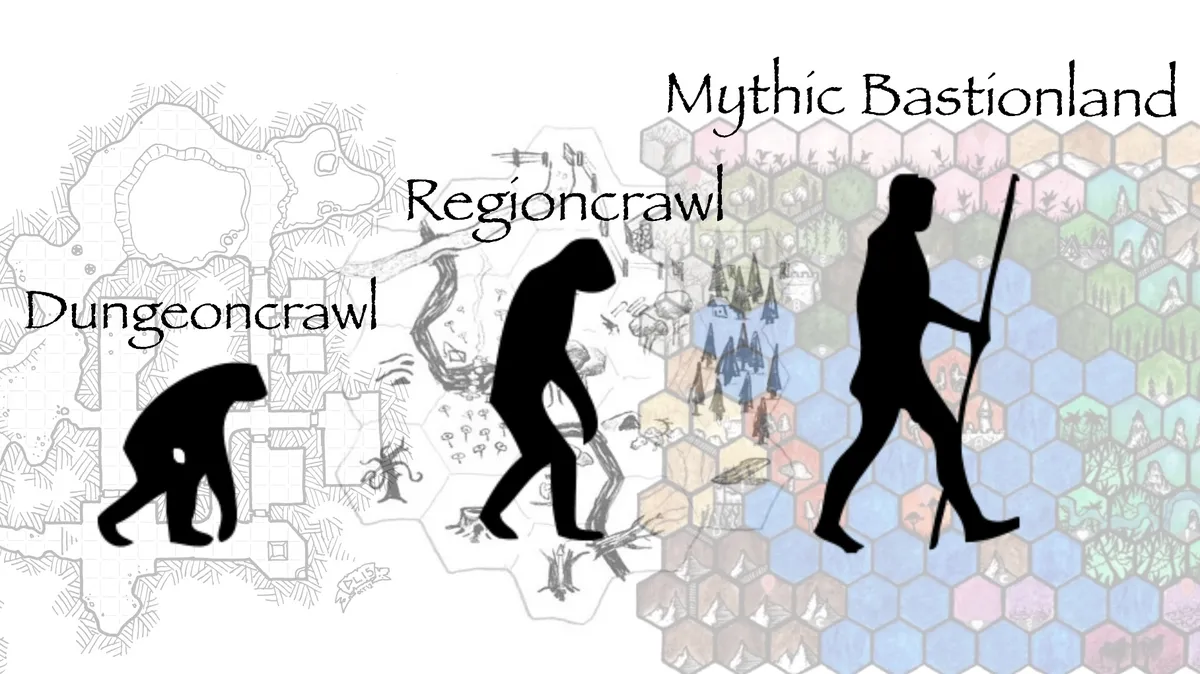
At this point, I am starting to think of OSR adventure design as a chain of evolution:
- Anti-heroic dungeoncrawls. You are an adventurer who wants treasure. Loot the dungeon to get it.
- Semi-heroic regioncrawls. You are an adventurer who wants treasure, but you also want to help the nearby town. Solve a mysterious crisis plaguing the town and you can expect to run into dungeons and treasure along the way.
- Heroic, Mythic Bastionland hexcrawls. You are a knight – you have a role in society! Solve mysterious crises plaguing the realm to gain Glory. No treasure or dungeons necessary.
The anti-heroic category is disappearing, as Gus L laments. The semi-heroic category contains the bulk of modern OSR adventures, including Mausritter’s example adventure, The House Under the Moondial, Tannic, The Evils of Illmire, etc. The heroic category is Chris McDowall taking the heroic and overland tendencies of modern OSR adventures to their logical conclusion.
So, we can see here how the dungeoncrawl vs. the overland crawl is not just a question of ease of design (as Gus L has argued) but a question of player fantasy as well. Modern players want to be heroes, especially in the absence of rival players to compete against.
I was thinking recently about compiling a sort of “Best of the Odd” ruleset that would roll back some of the innovations of Mythic Bastionland into a simpler, Into the Odd style game. But having reread Into the Odd for research, I just don’t want to make another game about being an explorer as opposed to a hero. It’s just not a compelling fantasy for me anymore.
The Gus Ls of the world will probably continue to lament the dying craft of designing complex, underground spaces. And yeah, there’s something sad about that, just like it’s sad that the world population of horses has declined because of the invention of the car and the train.
I don’t want to give up my car for a horse, though, as glad as I am that some people still keep the craft of horse-riding alive.